deciphering tunic
I bought Tunic a while ago when it was on special and I finally got around to playing it last week.
A core mechanic of the game is that instead of explicitly teaching you how to play, pages of the game’s “instruction manual” is scattered throughout the world for you to discover. This lets the game reveal the more advanced mechanics of the game to the player over time.
The catch? The instruction manual only has a smattering of English words! A large part of the manual is written in a unique script created by the game designers.
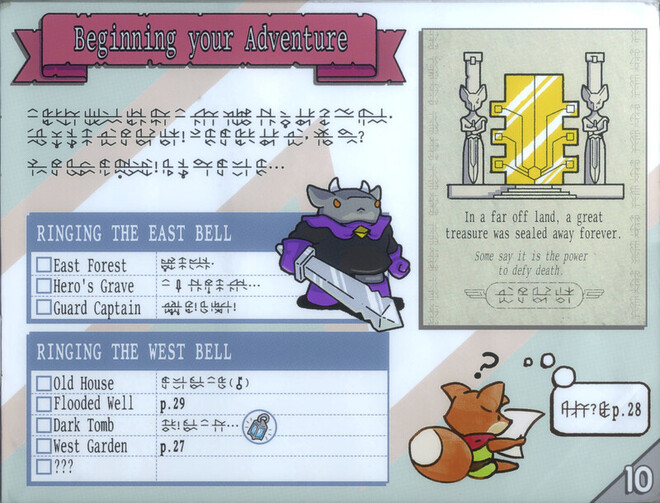 One of the first pages you find in the game.
That might sound counterintuitive, but the idea from the developers was to evoke that feeling of picking up a game as a kid and not being able to fully understand what’s going on, while still giving just enough information for you to figure out the game for yourself. The player isn’t expected to actually read the text.
But is it text?
At first, I didn’t pay too much attention to the script. There’s enough variation in the symbols to give the impression that it could plausibly be text, but it could also just be the work of a really talented designer. Eventually, the mystery got the better of me and I decided to give deciphering it a shot.
With absolutely zero background information, the only way to proceed was to make some educated guesses and cross-check them with other text to see if they hold. I started with some basic assumptions:
- The text is English.
- Each group of symbols connected by the centre line denotes a word.
- Given the amount of glyphs and how short each word appears, the system is some kind of syllabary based on English phonemes, not letters.
Making educated guesses
With that in mind, I skimmed through the manual looking for text next to pictures that could give a hint to its meaning. This text caught my eye:

Based on the picture, and the fact that page 28 was a map of one of the main
areas of the game, I thought there was a chance that this text reads, LOST? SEE p.28. I quickly jotted down in my notebook my first guesses:
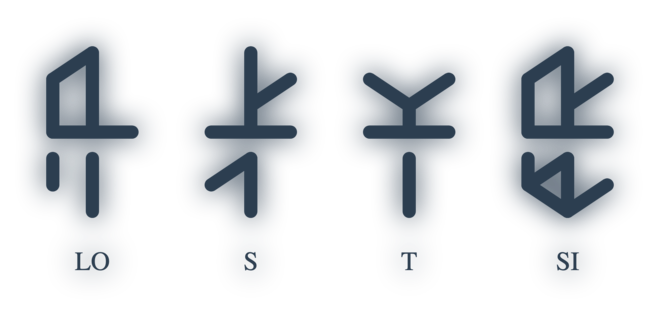
At this point, I had no idea how those glyphs mapped to those sounds, but at least I had a starting point. My next target was the heading on this page:
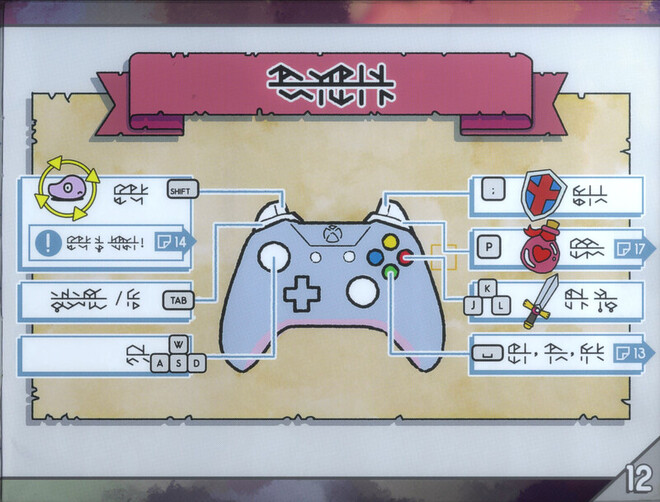
A very natural guess for this word is, of course, CONTROLS. There was no way
to validate this, but with a close look I saw that this could plausibly line up
with my previous guess:
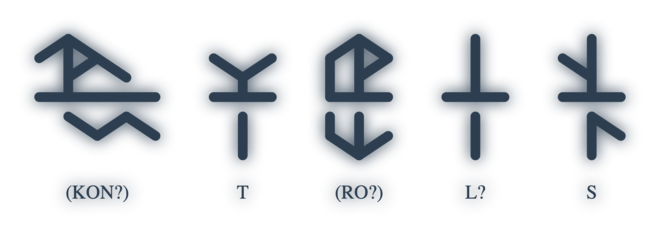 I got slightly lucky here, because I didn't notice at the time that the final glyph here is actually a flipped version of the S from earlier.
Next, I looked at the text next to the shield, which has the potential L
glyph in the middle.
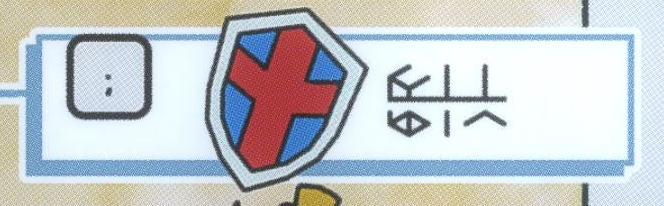
I initially thought this might be the word BLOCK, but it didn’t feel right.
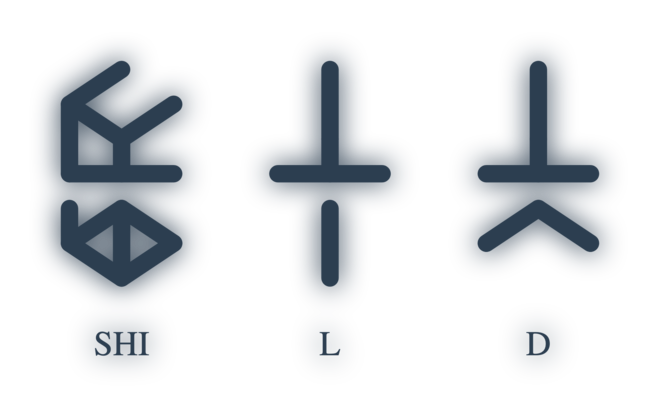
Instead, I made a wild guess and pencilled in SHIELD for this word instead.
That gave me a potential glyph for D (which eventually turned out to be
right!).
Then, I tackled the page explaining the space button, in particular the two actions on the right:
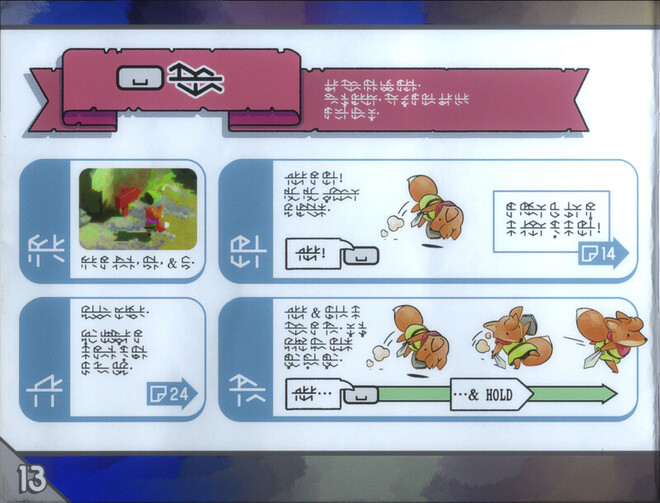
From playing, I knew that pressing space does a dive roll, while pressing and
holding spacing lets me run. Given that, my guesses here were ROLL and
RUN respectively:
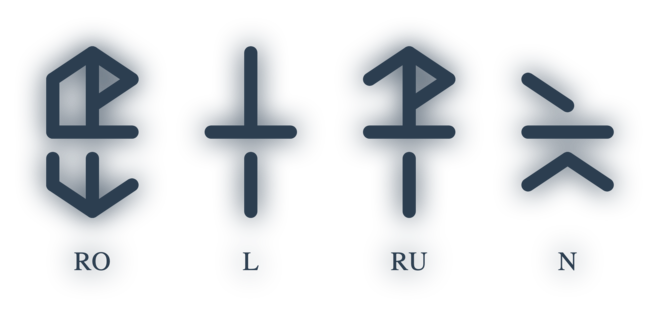
This would line up perfectly with the guesses for N and ROL in CONTROLS
from earlier, which gave me confidence that I was on the right track. Though my
understanding of the system was far from complete, I felt it was time to
try deciphering a major piece of text.
Where else but the first page to start? I went back and scribbled down a gloss for the first couple of words:

Treating this like a fill-in-the-blanks puzzle, I thought the second word could
be SECRET and the third word could be LEGEND. This gave me the following
guesses to add to my list of glyphs:
Consonants and vowels
All the pieces fit together well so far, so I had some confidence that my starting assumptions were correct. Treating the text as English worked, grouping the glyphs into words based on the centre line worked, and treating the glyphs as syllables also yielded plausible results. Still, I thought maybe there was more to the system: I felt that there was enough evidence to suggest that the syllables could be further deconstructed into consonants and vowels.
Grouping the syllables by consonant, you can see that they seem to share parts of their structure:
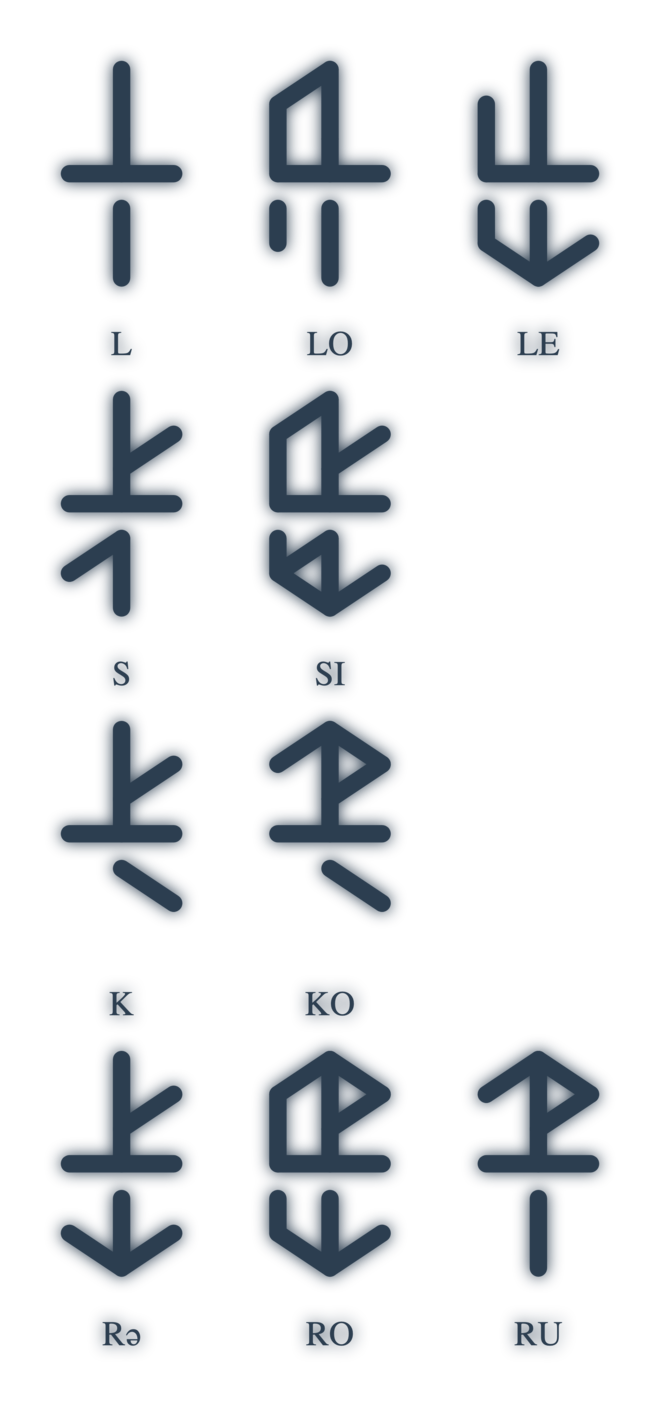 Some of these transcriptions aren't correct and still needed refinement, but they were what I had to work with at this stage.
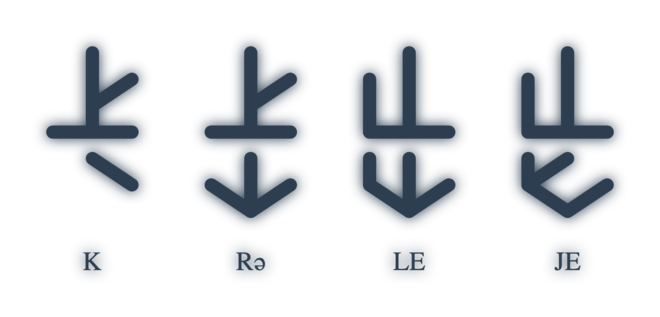
Sharing similar structures implied that further deconstruction is possible. For
example, I had potential glyphs for L, LE and JE. If we assumed that the
common parts of each glyph represented the consonant or vowel part of the
syllable, we could make a deduction like this:

This was the final clue that unlocked the rest of the script. With this, each glyph could be deconstructed into a consonant part (made up of the inside strokes of each glyph) and a vowel part (made up of the top, left and bottom strokes of the hexagon). With this principle in hand, the rest of the script becomes relatively straightforward to decipher. This is left as an exercise for the reader :)
Phonemes vs. letters
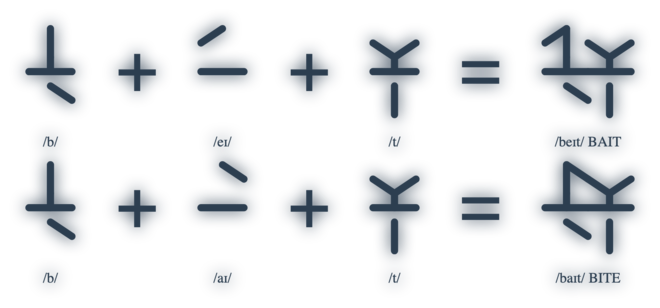
A core concept of this type of script is that it doesn’t use regular spelling for its words but instead it uses each word’s phonetic pronunciation as the basis of its spelling.
For example, take the words BAIT and BITE. Although BAIT is spelt with
“-ai-”, its phonetic value is EI (as in BEIGE). Conversely, while BITE is
spelt “-ite”, its phonetic value is AI (as in CHAI). This principle leads
to the following spellings:
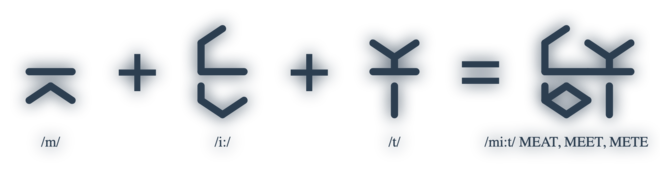
This principle also means that homophones that are spelt differently in regular
spelling become “homoglyphs” in the game script, such as in this example with
MEAT, MEET and METE:
One final piece of the puzzle
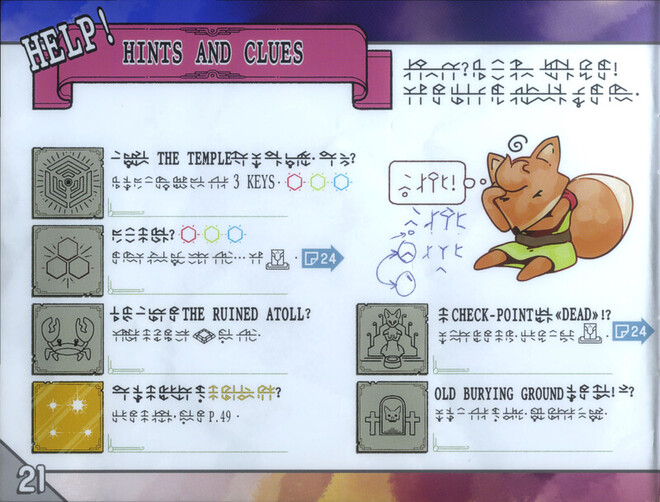
What we have so far deciphers most of the script, except for one feature: sometimes, the script includes a small circle under a glyph. Fortunately, the developers were kind enough to provide a hint on page 21 of the instruction manual. Notice the speech bubble with the circle under the first glyph, and the pen markings that seem to imply some kind of swapping or reordering:
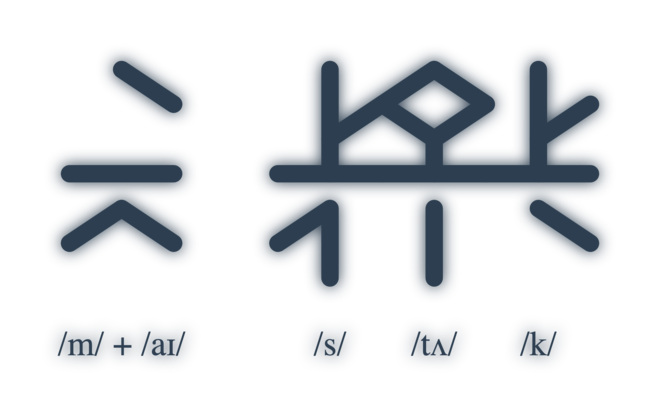
Applying what we know so far to translate this speech bubble, we get the phrase
MY STUCK, which doesn’t really make sense:
Using the hint, we could try swapping the order of the first syllable from M + AI to AI + M:
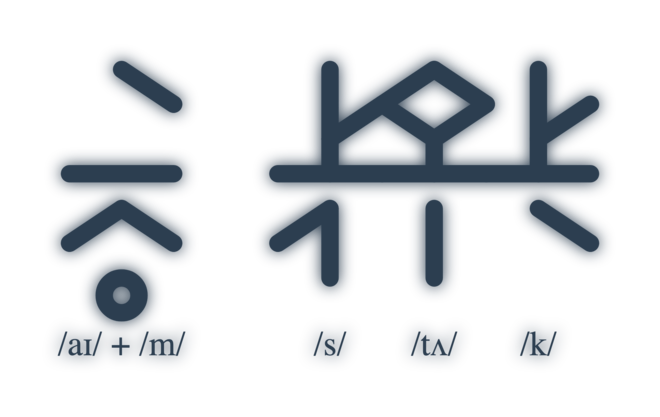
This gives a much more plausible (and correct) reading of I'M STUCK. In other
words, a circle reorders a syllable from consonant + vowel to vowel +
consonant. This gives words like ITEM, which is correctly written
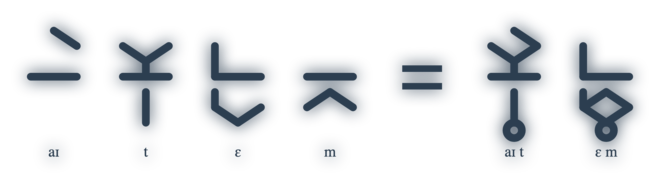
instead of the incorrect
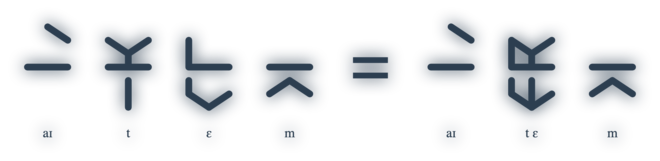 This is the wrong spelling.
Do you speak North American?
Given the variety of dialects of English in the world today, a phonetic script for English has the interesting consequence of forcing a particular accent on the reader.
For example, native speakers of English tend to pronounce the word THE
differently depending on whether the word that follows it begins with a vowel:
they will say /ðə/ banana (“the”) but /ði:/ apple (rhyming with
“thee”). The designers chose to enforce this distinction in the script, using
both spellings for the word THE depending on context:
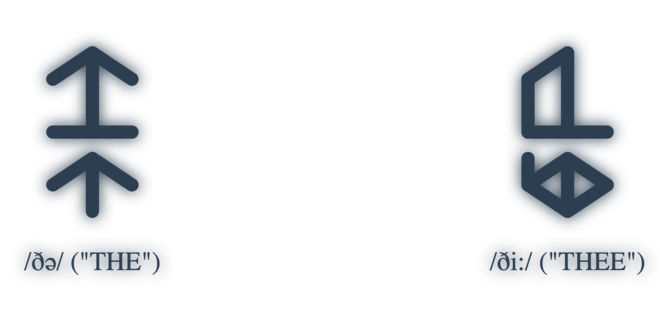
You can see this distinction in sentences like the following:
 Inscription reads: /ði:/ ("thee") heir hungers for reminders of /ðə/ ("the") corporeal world.
A variation like this is common to many English dialects, but as a native
speaker of New Zealand English, one variation that stood out to me is that the
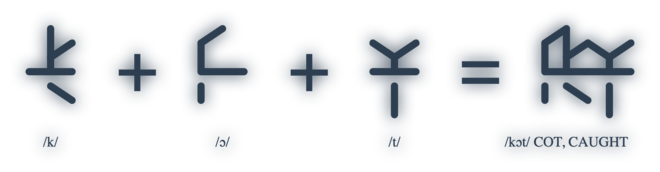
script only has one glyph for both the LOT and THOUGHT vowels. For example,
I (and probably Australian and UK speakers in general) pronounce COT as /kɔt/
and CAUGHT as /ko:t/, but there is no glyph available for the /o:/ sound. In
other words, the cot-caught
merger is required by
the script and gives the following homoglyph, even though in my native dialect
these words are not homophones:
A further quirk of the script is with the spelling of the schwa (/ə/). Though
the schwa is a common sound in English due to vowel
reduction, there is no dedicated
glyph for it. This meant that the developers had to repurpose other vowels for
this case, sometimes with the STRUT vowel /ʌ/, sometimes with the KIT vowel
/ɪ/, and sometimes even with the DRESS vowel /ɛ/! To me, it seems to be an
interesting design decision to enforce minor distinctions like the
pronunciation of THE while leaving out this major feature of English.
Consequently, we see words like CONTROL /kəntroʊl/ spelt /kʌtroʊl/,
BUTTON /bʌtən/ spelt /bʌtɪn/, and ITEM /aɪtəm/ spelt
/aɪtɛm/.
Final thoughts
In short - I love this script! It’s a unique idea, it gives a special flavour to the feel of the entire game and it makes a great side quest when you want a break from adventuring.
I wonder if the design might have been influenced by the Shavian
alphabet where voiced-unvoiced
consonant pairs are also flipped versions of each other – though in the game
script they are vertically flipped, whereas in the Shavian alphabet they’re
rotated 180º. I liked this design decision, because it meant that you could
make a good educated guess for the sound value of a glyph while deciphering
it. For example, once I had /ʒ/ from TREASURE I could pencil the flipped
glyph as a guess for /ʃ/.
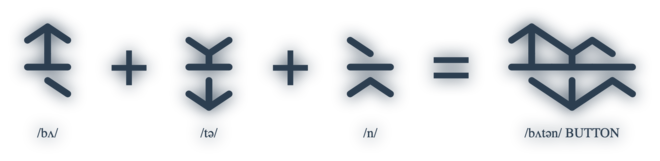
I also loved how the designers chose to style the writing by separately connecting the top and bottom parts, obfuscating how the letters work and making deciphering the script that much more fun. Consider the word button from the heading of page 13:
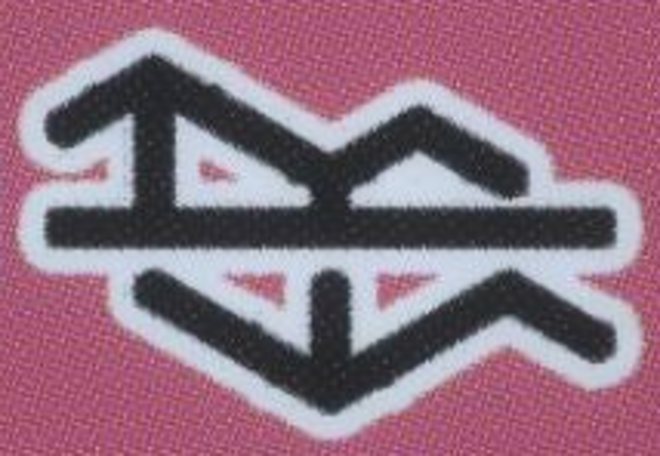
The way the border is styled implies that the top and bottom parts are somehow separate, when the glyphs are actually split like this:
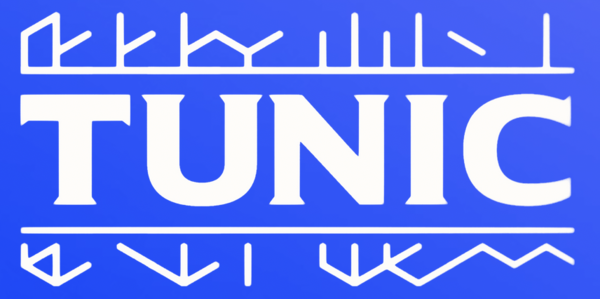
A prominent example of this is in the logo of the game, where they fully
separate the top and bottom parts of the phrase SECRET LEGEND by inserting
the English word TUNIC in-between the top and bottom parts!
This was a fun side quest and I think a great way to build up the game lore. With that done, time to get back to adventuring :D